

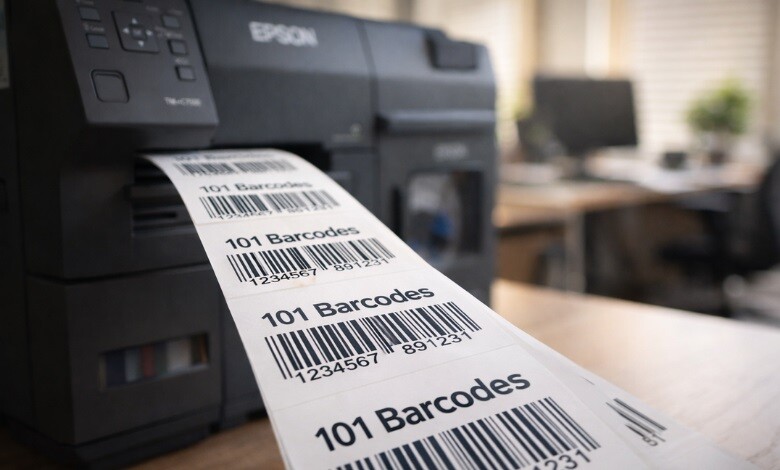
Barcodes. They seem like such a simple tool, don’t they? A few black lines and white spaces that you find on almost every product in your grocery cart, or even on the library book you’re checking out. Yet, behind their simplicity lies an incredible power that drives much of global commerce. From tracking products in massive warehouses to managing sales at retail counters, barcodes have revolutionized how businesses operate. If you’ve ever been curious about how barcodes function or why they are so widely used, you’re in the right spot. Welcome to Barcode 101: What You Need to Know, a deep dive into this essential technology.
-
 Primera LX910 Color Label Printer SKU: LX910$2,749.00
FREE SHIPPING over $199*
Orders before 12PM EST usually Ship Same Business Day -
 Epson C4000 / CW-C4000 ColorWorks Inkjet Label Printer (Gloss) SKU: C31CK03A9991$2,492.00
FREE SHIPPING over $199*
Orders before 12PM EST usually Ship Same Business Day -
 Afinia L801 Plus Commercial Color Label Printer SKU: 32498$8,850.00
FREE SHIPPING over $199*
Orders before 12PM EST usually Ship Same Business Day
What are Barcodes and Why Are They Used?
Barcodes are visual representations designed to be interpreted by machines. Essentially, they are a series of black lines and white spaces that encode information, which a scanner reads to gather specific details about the product they are associated with.
But why are these seemingly simple barcodes so widely used? The answer is efficiency. Barcodes provide businesses with a fast and reliable way to collect and store data, reducing the potential for human error and ensuring inventory and transaction accuracy.
So, what exactly are barcodes?
Barcodes are images composed of black bars and white spaces. These combinations represent data that is relayed to a computer or mobile device when scanned. Barcodes include numbers, letters, and other characters to provide further identification.
Barcodes Aid In
Barcodes assist businesses in several key ways, which is why they’re so integral to our daily lives. Barcodes serve a wide variety of purposes, including:
- Inventory Tracking & Management: Barcodes speed up and improve the accuracy of inventory management. Whether in warehouses or on retail shelves, barcodes help companies track stock levels, reduce errors, and save time on manual inventory tasks.
- Shipping & Transportation: Barcodes are used extensively in the logistics industry to track packages, shipments, and containers. Whether it’s a package being shipped internationally or a shipment moving through a warehouse, barcodes help ensure the product is at the right place at the right time.
- Product Identification: At the point-of-sale (POS), barcodes enable businesses to scan products and retrieve the necessary data (e.g., price, name, SKU). This speeds up the purchasing process and guarantees that customers are charged accurately.
- Lot Numbers & Organization: Barcodes are used to track batches of products, ensuring consistency, quality, and that products can be quickly recalled if needed.
All of these functions save businesses time, money, and effort, and they reduce human error.
Industries that Use Barcodes
Barcodes are essential in virtually every sector. They help industries improve operational efficiency, boost accuracy, and ensure that data is collected and tracked with ease. Here are some sectors that heavily depend on barcodes:
- Retail: From your local grocery store to large department stores, barcodes are used to track products, manage inventory, and streamline the checkout process.
- Warehouses & Logistics: These industries rely on barcodes to track packages, pallets, and shipments. Barcodes make it easier to track products across the supply chain and improve stock visibility.
- Healthcare: Barcodes are critical for tracking patient information, medications, and equipment. This ensures proper treatment and helps minimize errors.
- Libraries: Barcodes are used in libraries to track books, magazines, and other materials. They enable library staff to quickly identify, check out, and check in items.
- Automotive: Barcodes are essential in tracking parts and equipment in the automotive manufacturing and repair industries, ensuring that everything is in the right place.
How Does a Barcode Work?
It’s simple in theory, but the technology behind it is impressive. A barcode consists of a pattern of black bars (representing data) and white spaces (which act as separators). Each line and space represents a particular piece of data that is then converted into a readable format by a barcode scanner.
Let’s break it down:
Laser Scanner
The most common method for reading barcodes is using a laser scanner. When a barcode is scanned, the laser scanner identifies the alternating dark and light sections of the barcode. The scanner measures the difference in how the black bars absorb light and how the white spaces reflect light. This creates a signal that the scanner’s software can convert into data that a computer can understand.
It’s similar to reading Morse code – each unique sequence of bars and spaces corresponds to a specific set of numbers, letters, or symbols.
Quiet Zone
Every barcode has a blank area on either side, known as the Quiet Zone. The empty space around the barcode is crucial for helping the scanner recognize its beginning and end. Without the quiet zone, the scanner wouldn’t know where the barcode starts or finishes, making it unreadable. It’s a small, yet essential detail that ensures accuracy when scanning.
Types of Barcodes
Not all barcodes are created equal. Depending on the application and how much data needs to be encoded, barcodes come in two main types:
1-D (One-Dimensional) Barcodes and 2-D (Two-Dimensional) Barcodes.
1-D Barcode Types
1-D barcodes are the most common and the oldest form of barcodes. They are made up of a series of vertical black bars and spaces that represent data in a linear, one-dimensional format.
The two main types of 1-D barcodes are:
- Numeric-Only Barcodes: These barcodes consist of numbers only (e.g., 0-9). These barcodes are frequently used in retail and inventory management systems.
- Alpha-Numeric Barcodes: These can store both numbers (0-9) and letters (A-Z). They are used when more detailed information is required.
While 1-D barcodes are efficient, they can only store a limited amount of information, typically between 8 and 25 characters.
Various Types of 1-D Barcodes
- UPC-A: A standard barcode found on most products in the United States.
- UPC-E: A compressed version of the UPC-A code, used for smaller products.
- EAN-13: Used internationally, especially for retail products.
- Code 128: Used for shipping and packaging labels.
- EAN-8: A shortened version of EAN-13 used for smaller packaging.
- Code 39: A barcode commonly found in manufacturing and inventory systems.
- Interleaved 2 of 5: Often used for packaging and logistics tracking.
How to Read a UPC Barcode
A UPC-A barcode is made up of 12 digits: the first digit identifies the product category, the next five digits represent the manufacturer, the following five digits specify the product, and the final digit is a check number to ensure the barcode is read correctly. Upon scanning, the barcode’s black-and-white line pattern is translated into data, which is then processed by a computer system.
UPC vs SKU
You might have heard the terms UPC and SKU thrown around, especially in retail environments. Even though both are used to track products, they each serve distinct functions:
UPC (Universal Product Code): A widely used barcode format for product identification in retail.
- For external or universal use
- It follows a standard format for businesses and corporations.
- Numeric-only
- Used in retail
- Can be registered with the GS1 organization
- Must be purchased and licensed
- Remains constant throughout the product shelf life
SKU (Stock Keeping Unit): A unique internal code used by businesses to track and manage products, allowing customization to fit the company’s specific requirements.
- For internal use
- Unique to a particular company
- Alpha-numeric
- Used by warehouses, marketplaces, fulfillment centers, & e-Commerce sites
- More customizable tracking of products
- Used for internal operations & inventory tracking
While the UPC is used by retailers and manufacturers for external sales, SKUs are typically used internally for inventory management.
Types of 2-D Barcodes
- QR Code
- Data Matrix
- PDF 417
- MaxiCode
- Aztec
2-D barcodes, or two-dimensional barcodes, take barcode technology to the next level. Unlike 1-D barcodes, which store information in one direction, 2-D barcodes store data both horizontally and vertically. This enables them to store significantly more data.
QR Code
The QR Code (Quick Response Code) is among the most commonly used 2-D barcodes. QR codes can store far more data than 1-D barcodes, making them ideal for applications where more information is needed. QR codes are commonly employed in promotions, event access, and even for facilitating mobile transactions.
You can easily scan a QR code with the camera on your smartphone or tablet. Most smartphones have built-in scanners, so you just need to point your camera at the code for instant reading. Within seconds, the code is decoded, and the device either takes you to a webpage or displays relevant information.
2-D barcodes, including QR codes, are great for small items or products with a lot of data. They’re also more reliable when it comes to printing quality; even if the barcode is damaged or has low resolution, it can still be read.
Where Do We Go From Here?
So, now that you have a basic understanding of barcodes, how do you move forward with implementing them for your business? If you haven’t considered it yet, now is the perfect time to start using barcodes for inventory management, shipping, or customer tracking. With the rapid development of barcode technology, there has never been a better time to integrate it into your business.
At TCS Digital Solutions, we offer top-quality Barcode Label Printers that make it easy to print your own barcodes. Whether you’re looking to streamline your retail operations, manage a warehouse, or track shipments, having the right equipment is key.
-
 Epson ColorWorks C8000 Gloss Inkjet Color Label Printer SKU: C31CL02A9991$9,630.00
FREE SHIPPING over $199*
Orders before 12PM EST usually Ship Same Business Day - Primera LX600 Color Label Printer SKU: LX600$1,995.00
FREE SHIPPING over $199*
Orders before 12PM EST usually Ship Same Business Day -
 Epson ColorWorks CW-C6000A Gloss Color Inkjet Label Printer with Auto Cutter SKU: C31CH76A9991$3,059.00
FREE SHIPPING over $199*
Orders before 12PM EST usually Ship Same Business Day
Final Takeaway
Barcodes go far beyond just lines and spaces; they form the backbone of modern data collection and management. From improving inventory control to speeding up checkouts at the retail counter, barcodes play a crucial role in making businesses run smoothly. Whether you’re just getting started or looking to upgrade your barcode system, understanding how barcodes work is the first step in improving your operations.
If you have questions about barcode label printers, feel free to contact our support team via email at orders@tcsdigitalsolutions.com or give us a call at +1 (762) 208-6985. Our expert support team at TCS Digital Solutions will be happy to assist you. To learn more about barcode label printers, visit our blog section and get answers to all your questions.

