

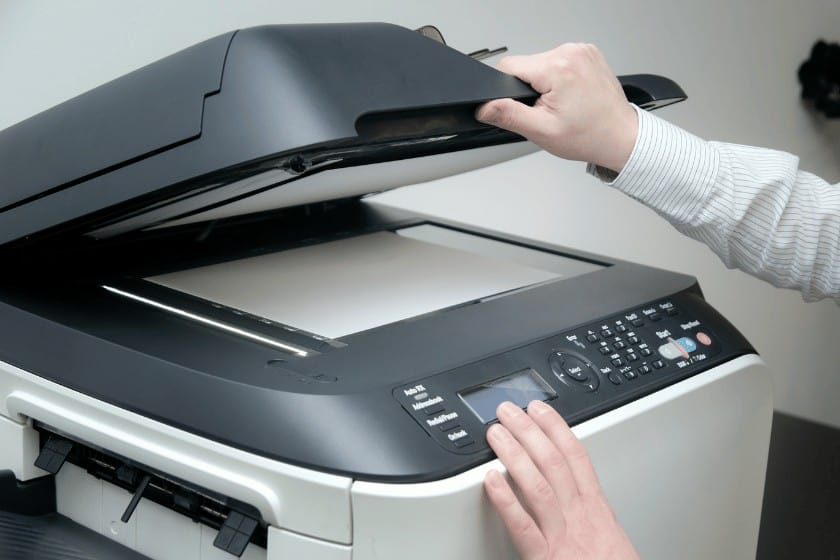
 Scanning documents has become an indispensable part of modern office and home workflows. The process simplifies storing, sharing, and organizing physical documents by converting them into digital format. If you’re seeking guidance on how to scan a document from your printer to your computer, you’re in the right place. The steps you’ll find in this comprehensive guide include many valuable tips, so you’ll know exactly how to go about it.
-
 Quick Label QL-300 (120V) Toner CMYK Color Label Printer SKU: 1003-0000002$9,970.00
FREE SHIPPING over $199*
Orders before 12PM EST usually Ship Same Business Day - Epson ColorWorks C3500 Inkjet Color Label Printer SKU: C31CD54011 GTIN: 814420980046$2,492.00
FREE SHIPPING over $199*
Orders before 12PM EST usually Ship Same Business Day -
 Afinia L301 Small Business Color Label Printer SKU: 26849 GTIN: 678621130057$1,249.00
FREE SHIPPING over $199*
Orders before 12PM EST usually Ship Same Business Day
How Do I Scan Documents on a Printer?
Before we delve into the detailed steps, let’s grasp the fundamental process of scanning documents on a printer. Most contemporary printers come equipped with scanning capabilities, either through a built-in scanner or an external scanning module. Here is a quick rundown of the process:
Prepare Your Document
Your printer’s design will determine whether you should place the document face-down on the scanner bed or in the document feeder.
Access the Scanner
Navigate to the scanning option on your printer’s control panel or touchscreen interface. This may be labeled “Scan,” “Scan to Computer,” or a similar term.
Select Scan Settings
Choose your preferred scanning settings, such as color mode (black and white, grayscale, or color), resolution (measured in DPI—dots per inch), and file format (PDF, JPEG, etc.).
Preview the Scan
Most printers offer a preview option, allowing you to preview how the scanned document will appear. Use this to make adjustments to positioning and settings if necessary.
Scan the Document
The scan will begin as soon as the settings are satisfactory and the preview has been viewed. The printer will feed the document through the scanning mechanism.
Save the Scan
After completing the scan, you can opt to save the scanned document to your computer, either directly to your preferred location or through scanning software.
Now, let’s proceed with a more detailed breakdown of the steps involved in scanning a document from a printer to a computer.
-
 Primera LX910 Color Label Printer SKU: LX910$2,749.00
FREE SHIPPING over $199*
Orders before 12PM EST usually Ship Same Business Day -
 Epson ColorWorks CW-C6000A Matte Color Inkjet Label Printer with Auto Cutter SKU: C31CH76A9981$3,059.00
FREE SHIPPING over $199*
Orders before 12PM EST usually Ship Same Business Day -
 Afinia L801 Plus Commercial Color Label Printer SKU: 32498$8,850.00
FREE SHIPPING over $199*
Orders before 12PM EST usually Ship Same Business Day
How Do I Scan Documents From Printer to Laptop?
Step 1: Prepare Your Document
Ensure the document you wish to scan is free from wrinkles, tears, or staples. Be sure the document feeder is correctly loaded or that it is facing the scanner bed.
Step 2: Access the Scanner
Locate the scanning option on your printer’s control panel or touchscreen interface, where you will initiate the scanning process. Depending on your printer model, this option may have varying labels, but it typically includes terms like “Scan,” “Scan to Computer,” or “Scanner.”
Step 3: Select Scan Settings
- Upon accessing the scanning option, you’ll be prompted to select various scan settings, including:
- Color Mode: Choose between black and white, grayscale, or color scanning.
- Resolution: Specify the resolution in DPI (dots per inch), where higher DPI values yield higher-quality scans but result in larger file sizes.
- Save the scanned document in the format you prefer (such as PDF, JPEG, or TIFF).
Step 4: Preview the Scan
Printing previews is an option available on many printers that lets you see what the scanned document looks like before printing it. You can use this feature to verify that the settings are aligned with your requirements and ensure proper positioning
Step 5: Scan the Document
As soon as you’re satisfied with the settings and preview, start the scanning process. Your printer will feed the document through the scanning mechanism, processing the scanned image or document.
Step 6: Save the Scan
In most cases, the scanned document will be saved to your computer after scanning has been completed. Select the location for saving the file and assign it a suitable name for easy access in the future.
How to Scan From Printer to Computer?

Now that you’ve acquired a comprehensive understanding of the step-by-step process for scanning documents from a printer to a laptop, it’s worth noting that some printers offer additional features that simplify the scanning process further. For instance, certain printers provide wireless scanning, enabling direct scanning to your computer via a Wi-Fi network, eliminating the need for a USB connection.
TCS Digital Solutions Provides Label Printer Solutions
For printing requirements extending beyond document scanning, TCS Digital Solutions emerges as a dependable provider of label printers. Label printers are indispensable for businesses and organizations that demand high-quality, customized labels for products, shipping, barcoding, and more.
TCS Digital Solutions offers a range of label printer solutions tailored to diverse printing needs. These label printers are renowned for:
- High-Quality Printing: TCS label printers produce sharp and clear prints, ensuring professional and legible labels.
- Durability: Labels printed with TCS label printers are engineered to withstand varying environmental conditions, including exposure to moisture, heat, and UV light.
- Customization: You can design and print custom labels to suit your precise requirements, whether it’s product labels, barcodes, QR codes, or shipping labels.
- Ease of Use: TCS label printers are user-friendly, featuring intuitive software for label design and printing, simplifying the creation of customized labels.
- Versatility: These printers accommodate various label sizes and materials, providing flexibility in your labeling tasks.
- Reliability: TCS label printers are recognized for their reliability and consistent performance, ensuring efficient completion of your labeling tasks.
In summary, TCS Digital Solutions delivers label printer solutions catering to the diverse labeling needs of businesses and organizations. Whether you need product labels, shipping labels, or barcodes, TCS label printers offer the quality, durability, and customization options essential for your labeling requirements.
-
 Primera LX3000 Color Label Printer with Big Ink, Dye Ink SKU: LX3000-dye$3,195.00
FREE SHIPPING over $199*
Orders before 12PM EST usually Ship Same Business Day - Afinia LT5C CMYK + White Label Printer SKU: 36138$12,850.00
FREE SHIPPING over $199*
Orders before 12PM EST usually Ship Same Business Day - Quick Label QL-120X Inkjet Color Label Printer with 2 Year Warranty SKU: 42725200$8,395.00
FREE SHIPPING over $199*
Orders before 12PM EST usually Ship Same Business Day
Conclusion
Adding scanned documents to your document management workflow is a straightforward task that can significantly improve your efficiency. Whether you’re digitizing essential paperwork, creating digital archives, or seeking a convenient way to save and share documents, scanning proves to be a valuable tool in your arsenal.
Furthermore, for businesses and organizations requiring high-quality label printing solutions, TCS Digital Solutions offers reliable and versatile label printers to fulfill a range of labeling needs.
Related Articles

